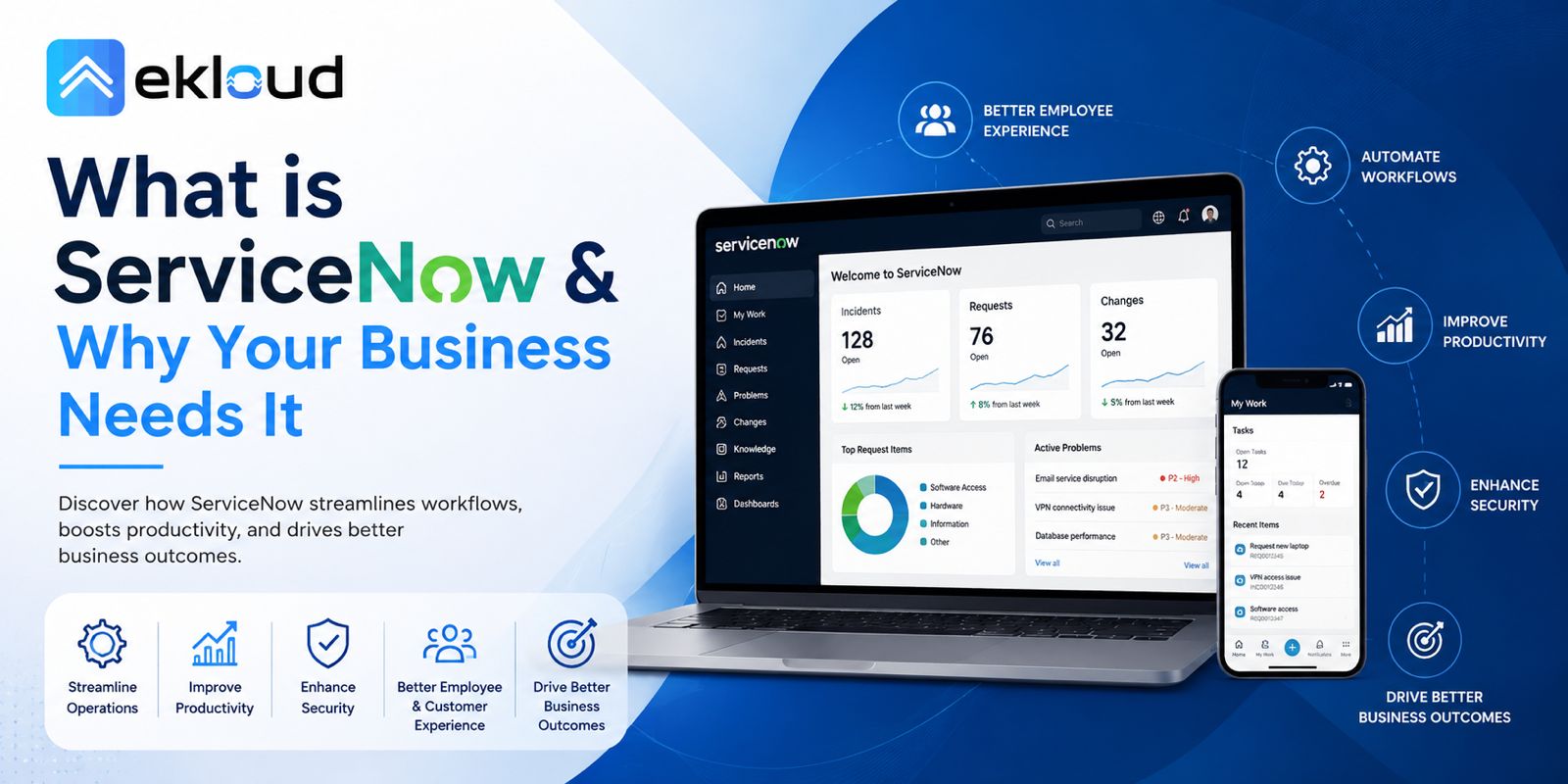
What is ServiceNow & Why Your Business Needs It
Introduction
In today's fast-paced and competitive business environment, managing enterprise operations has become more challenging than ever. Many organizations still depend on emails, spreadsheets, and outdated tools to handle daily activities, which often results in inefficiencies, poor visibility, and slower project delivery. To stay ahead, businesses need modern solutions that enable automation, streamline operations, improve collaboration, and enhance overall productivity.
This is where ServiceNow comes into the picture. ServiceNow is a cloud-based SaaS platform designed to automate and manage workflows across IT, HR, customer service and other business functions. It is widely used by industries such as healthcare, banking, finance, IT and education to improve service delivery and operational efficiency.
In this blog, we will explore ServiceNow's key features, business benefits, implementation best practices, industry use cases, and why it has become one of the most important platforms for digital transformation.
2. What is ServiceNow?
ServiceNow is a cloud-based Software-as-a-Service (SaaS) platform that helps organizations automate, manage, and streamline their business processes through digital workflows. Initially developed as an IT Service Management (ITSM) solution, ServiceNow has evolved into a comprehensive enterprise platform that supports IT, Human Resources, Customer Service, Security Operations, Finance, and many other business functions.
The platform enables businesses to replace manual tasks, emails, and spreadsheets with automated workflows, improving efficiency, transparency, and collaboration across teams. With features such as incident management, service requests, asset management, workflow automation, and real-time reporting, ServiceNow helps organizations deliver better services, reduce operational costs, and accelerate digital transformation initiatives.
3. Key Features of ServiceNow
ServiceNow offers a wide range of features that help organizations automate processes, improve service delivery, and enhance operational efficiency.
Workflow Automation
Automates repetitive tasks and business processes to reduce manual effort and increase productivity.
IT Service Management (ITSM)
Manages incidents, service requests, problems, changes, and IT assets from a single platform.
Self-Service Portal
Allows employees and customers to raise requests, track issues, and access knowledge resources independently.
Real-Time Reporting and Dashboards
Provides actionable insights through customizable reports, KPIs, and analytics.
Integration Capabilities
Seamlessly connects with third-party applications, enterprise software, and cloud platforms.
AI and Machine Learning
Uses virtual agents, predictive intelligence, and automation to improve user experiences and operational efficiency.
Mobile Accessibility
Enables users to manage tasks and access services anytime and anywhere through mobile applications.
4. How Does ServiceNow Work?
ServiceNow connects people, processes, and systems through a unified cloud-based platform.
The process typically works as follows:
- Users submit requests through a self-service portal, email, mobile app, or chatbot.
- Requests are automatically routed to the appropriate teams using predefined workflows and business rules.
- Approvals, escalations, and notifications are automated to reduce manual effort.
- Data is stored in a centralized system, providing complete visibility into operations.
- Real-time dashboards and reports help managers monitor performance and service quality.
- Integration capabilities allow different business applications to work together seamlessly.
- AI-powered features assist in faster issue resolution and improved decision-making.
By automating routine operations, ServiceNow enables organizations to deliver services faster and operate more efficiently.
5. Why Do Businesses Need ServiceNow?
Modern businesses face increasing pressure to reduce costs, improve productivity, and deliver exceptional customer experiences. Traditional methods involving spreadsheets, emails, and disconnected systems often create inefficiencies and slow down business operations.
ServiceNow helps organizations overcome these challenges by providing a unified platform for workflow automation and service management.
Key Reasons Businesses Need ServiceNow:
- Automates routine business processes.
- Reduces manual errors and operational costs.
- Improves employee productivity.
- Enhances customer and employee experiences.
- Supports digital transformation initiatives.
- Provides real-time insights for better decision-making.
- Easily scales with growing business needs.
By implementing ServiceNow, organizations become more agile, efficient, and competitive in today's digital landscape.
6. Top Business Challenges Solved by ServiceNow
Businesses across industries face several operational challenges that can impact productivity and growth. ServiceNow helps address these challenges through intelligent automation and centralized service management.
Manual and Repetitive Processes
ServiceNow automates routine tasks, reducing human errors and increasing operational efficiency.
Poor Cross-Department Collaboration
The platform connects multiple departments through unified workflows and shared information.
Slow Incident Resolution
Automated ticket routing and escalation processes ensure faster problem resolution.
Limited Visibility into Business Operations
Real-time dashboards provide complete visibility into incidents, assets, and workflow performance.
Compliance and Security Challenges
ServiceNow supports governance, risk management, and security operations to maintain regulatory compliance.
High Operational Costs
Automation reduces manual work, helping organizations optimize resources and lower costs.
7. Industries That Benefit from ServiceNow
ServiceNow provides value across multiple industries by improving operational efficiency and service delivery.
Healthcare
- Streamlines healthcare IT operations.
- Supports compliance management.
- Enhances employee service experiences.
Banking and Financial Services
- Improves risk and compliance management.
- Automates customer support processes.
- Strengthens security operations.
Information Technology
- Manages incidents, changes, and assets effectively.
- Improves IT service delivery.
- Reduces system downtime.
Manufacturing
- Automates operational workflows.
- Optimizes supply chain processes.
- Improves maintenance management.
Education
- Supports digital campus initiatives.
- Enhances IT support services.
- Simplifies student and employee requests.
Retail and E-commerce
- Improves customer service experiences.
- Streamlines internal operations.
- Supports scalable business growth.
8. Benefits of Implementing ServiceNow
Implementing ServiceNow delivers significant business benefits that extend beyond IT operations.
Major Benefits Include:
- Increased operational efficiency.
- Reduced manual work and errors.
- Lower operational costs.
- Faster service delivery.
- Improved employee satisfaction.
- Better customer experiences.
- Enhanced security and compliance.
- Real-time reporting and analytics.
- Greater scalability and flexibility.
Organizations that implement ServiceNow effectively can improve productivity while accelerating digital transformation.
9. ServiceNow Use Cases
ServiceNow supports a wide range of business functions through specialized solutions.
IT Service Management (ITSM)
- Incident Management.
- Change Management.
- Problem Management.
- Asset Management.
- Service Request Management.
Human Resources (HR)
- Employee onboarding and offboarding.
- HR service delivery automation.
- Employee self-service portals.
- Leave and benefits management.
Customer Service Management (CSM)
- Customer support case management.
- Automated ticket routing.
- Omnichannel service experiences.
Security Operations (SecOps)
- Security incident management.
- Threat intelligence integration.
- Vulnerability response automation.
IT Operations Management (ITOM)
- Infrastructure monitoring.
- Cloud resource management.
- Event management automation.
10. Why Choose ServiceNow Over Traditional Systems?
Traditional systems often rely on disconnected tools, spreadsheets, and manual processes that limit efficiency and scalability.
ServiceNow provides a modern, integrated approach that helps organizations adapt to changing business requirements and technological advancements.
11. Best Practices for Successful ServiceNow Implementation
Successful ServiceNow implementation services require careful planning and execution.
Define Clear Business Objectives
Establish measurable goals and align the implementation with business priorities.
Involve Key Stakeholders
Engage departments and users throughout the implementation process to ensure adoption.
Start Small and Scale Gradually
Begin with high-impact use cases before expanding across the organization.
Focus on User Training
Provide adequate training to maximize user adoption and productivity.
Avoid Over-Customization
Leverage standard ServiceNow capabilities whenever possible to simplify maintenance and upgrades.
Continuously Optimize Processes
Regularly review workflows and performance metrics to improve efficiency.
12. How Ekloud Helps Businesses with ServiceNow
At Ekloud, we help organizations unlock the full potential of ServiceNow by delivering customized solutions that improve operational efficiency and accelerate digital transformation.
Our experienced professionals work closely with businesses to understand their unique challenges and implement solutions that deliver measurable results.
Our ServiceNow Services Include:
ServiceNow Consulting
We assess business requirements and develop strategic implementation roadmaps aligned with organizational goals.
End-to-End Implementation
Our team manages the complete implementation process, from planning and configuration to deployment and user adoption.
Workflow Automation
We automate business processes across IT, HR, customer service, and other departments to improve efficiency and reduce costs.
Custom Development and Integrations
We build customized applications and integrate ServiceNow with enterprise systems, CRMs, ERPs, and third-party platforms.
Migration and Upgrade Services
We help organizations migrate from legacy systems and upgrade existing ServiceNow environments seamlessly.
Managed Support Services
Our experts provide ongoing maintenance, monitoring, optimization, and technical support to maximize platform performance.
Why Partner with Ekloud?
- Experienced ServiceNow professionals.
- Tailored solutions for every business.
- Faster deployment and implementation.
- Cost-effective digital transformation services.
- Dedicated post-implementation support.
- At Ekloud, we enable businesses to create intelligent workflows, improve service delivery, and build future-ready digital enterprises through ServiceNow solutions.
13. Future of ServiceNow
The future of ServiceNow is driven by advancements in AI, automation, and cloud technologies.
Generative AI Integration
AI-powered capabilities will automate content creation, incident summaries, and intelligent recommendations.
Low-Code Development
Organizations can build applications faster using low-code and no-code development tools.
Hyperautomation
Businesses are combining AI, machine learning, and robotic process automation with ServiceNow workflows to achieve greater efficiency.
Enterprise-Wide Adoption
ServiceNow continues to expand beyond IT into HR, finance, procurement, customer service, and legal operations.
As digital transformation accelerates, ServiceNow will remain a critical platform for organizations seeking innovation, agility, and operational excellence.
14. Conclusion
ServiceNow has evolved into one of the world's leading enterprise workflow automation platforms. It helps organizations automate processes, improve collaboration, enhance service delivery, and accelerate digital transformation.
From healthcare and banking to manufacturing and education, businesses across industries rely on ServiceNow to streamline operations and improve customer and employee experiences.
However, successful implementation requires the right expertise and strategic guidance. Partnering with experienced ServiceNow professionals ensures organizations maximize their return on investment and achieve long-term business value.
At Ekloud, we help businesses implement, customize, integrate, and optimize ServiceNow solutions tailored to their specific needs. Our goal is to enable organizations to build smarter, more efficient, and future-ready operations through intelligent automation.
Ready to transform your business with ServiceNow?
Connect with Team Ekloud today and accelerate your digital transformation journey.
📩 contact@ekloudservices.com
🌐 www.ekloudservices.com
Related Insight
Top AI Tools for Businesses to Use in 2027: The Ultimate Guide to Working Smarter
Artificial Intelligence is no longer just a buzzword—it's becoming a part of everyday business.
Why Bharat Dreamin' 2026 Is a Must-Attend Event for Salesforce Professionals
The Salesforce ecosystem in India continues to grow at an incredible pace, creating new opportunities for professionals, businesses and innovators.